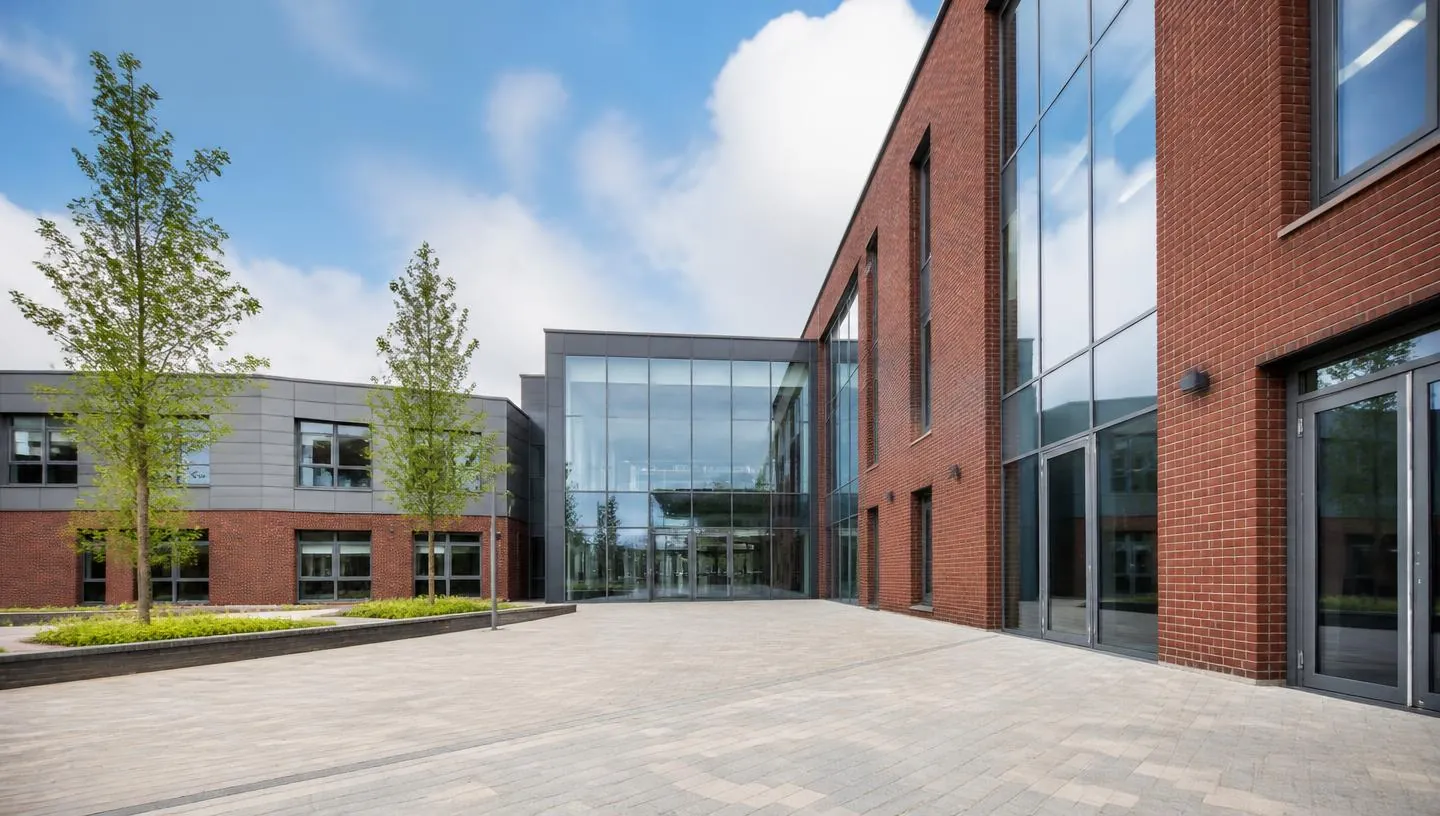
Appointing a cleaning contractor for a school is not the same as appointing one for an office. The building is the same in principle — floors, washrooms, windows, gutters — but the buyer is different, the calendar is different, and the checks are considerably more demanding.
School cleaning services sit inside a safeguarding framework that most commercial cleaning companies never encounter. Get the checks wrong and a contractor cannot lawfully be left alone on site. Get the scheduling wrong and the work either disrupts teaching or never happens at all.
This guide sets out what a school business manager, site manager or academy trust estates lead should expect from a cleaning contractor, and what to ask before signing anything. It is written ahead of the 2026 edition of Keeping Children Safe in Education, which comes into force on 1 September 2026.
What school cleaning services actually cover
Most tenders concentrate on daily cleaning, and that is the visible half of the job: classrooms, corridors, halls, staff rooms, washrooms, waste. It determines whether the school looks cared for on a Monday morning.
The other half is periodic, and it is the half that quietly falls behind:
- Internal and external window cleaning, including classroom glazing at height
- Atrium and high-level glazing, common in newer builds and sixth-form blocks
- Skylights, internal and external where access allows
- External louvres and cladding panels
- Gutter and fascia clearance across multiple roof lines
- Communal and circulation areas on larger campuses
- Bird proofing, where pigeons have colonised roof voids, canopies or solar arrays
These items rarely appear on a weekly schedule. They appear once or twice a year, they need access equipment, and they are the reason a school estate either holds its condition or slowly deteriorates. When a school issues a summer maintenance tender, this is usually what it is asking for.
Enhanced DBS or enhanced with barred list: which does a school cleaning contractor need?
This is the question that causes the most confusion, and the answer is not "everyone needs the highest level of check."
The distinction turns on whether the work counts as regulated activity — a legal term defined in the Safeguarding Vulnerable Groups Act 2006, broadly covering close, regular or unsupervised contact with children in a specified setting such as a school.
Contractors engaged in regulated activity require an enhanced DBS check including children's barred list information.
Contractors not in regulated activity, but whose work gives them the opportunity for regular contact with children, require an enhanced DBS check without barred list information.
The practical test is supervision. Where a contractor always works with a member of school staff present, the work does not constitute regulated activity, and a barred list check is not required.
For external cleaning work this matters a great deal. A team clearing gutters and cleaning high-level glazing during the summer holidays, on a site with no pupils present, is in a very different position from a cleaner working through the school day in occupied corridors. A contractor who understands that distinction, and can tell you honestly which category their team falls into, is a contractor who has worked in education before.
One point worth knowing when comparing quotes: if a cleaning contractor is self-employed, the school itself has to obtain the DBS check, because self-employed individuals cannot apply to the DBS directly on their own account. If the contractor is employed by a company, the school instead obtains written confirmation from the employer that the necessary checks have been carried out. For a school with limited administrative capacity, appointing an established company rather than a sole trader removes that burden entirely.
Safeguarding and contractor access to school sites
Checks are only the first layer. Schools are expected to verify the identity of contractors and their staff on arrival, and to have signing-in arrangements that are actually followed.
For contractors visiting regularly, details must be recorded on the school's Single Central Record and cross-referenced with a letter of assurance from the employer confirming that the required checks have been completed. A contractor who supplies that letter without being chased is saving the business manager real time.
Beyond the paperwork, a competent contractor should arrive already knowing:
- Which areas are out of bounds during the school day
- That equipment, chemicals and access gear are never left unattended in pupil areas
- That photography on site, including progress photos for the contractor's own records, needs explicit permission
- Who the site contact is, and that nobody starts work without checking in
None of this is exotic. But it is the difference between a contractor a school invites back and one it quietly replaces.
Term-time or school holidays: when should the work be scheduled?
School estates work runs on a calendar that has nothing to do with the commercial year.
Daily cleaning happens in term time, almost always outside teaching hours — early morning or after the last bell, with careful handling of after-school clubs and lettings.
Everything requiring access equipment happens in the holidays. Cherry pickers, towers, rope access and pressure washing need an empty site. In practice that means the summer break, with Easter and October half-term as secondary windows. Cleaning high-level glazing in October with 900 pupils on site is not a scheduling problem, it is a safety one.
This has a procurement consequence that catches schools out every year: the tender needs to go out in spring, not in July. Contractors capable of high-level work have finite summer capacity and it fills quickly. A quotation request issued in late July, covering works across multiple campuses, leaves very little room for the site visits that produce an accurate price.
Multi-site trusts should also expect a contractor to sequence sites rather than treat them as one job. Two campuses ten miles apart have different roof lines, different access constraints and different traffic arrangements. A single blended price usually means one of them has not been surveyed properly.
How to choose cleaning companies for schools: a 7-point checklist
- Public liability insurance at a level appropriate to the site, with the certificate provided up front rather than on request.
- DBS position stated clearly — which level, for which staff, and on what basis. A contractor who cannot explain the regulated activity distinction has not worked in education.
- Letter of assurance available for the Single Central Record, without prompting.
- Working-at-height competence — IPAF or PASMA certification where powered access or towers are used, and RAMS supplied before work starts, not after.
- Education references, ideally from schools or colleges of comparable size and layout.
- TUPE position understood, if an existing cleaning team is being transferred.
- A quotation that separates the elements — daily cleaning, periodic external works, access equipment, and any exclusions or assumptions stated in writing.
The seventh point saves the most money. A single lump sum invites disputes later about what was and was not included. An itemised quotation lets the school flex the scope to the budget. Many of these principles apply to any commercial contract — our guide on how to choose a commercial cleaning partner covers the wider version.
Frequently asked questions
Do school cleaners need an enhanced DBS check? Yes, in almost all cases. Whether it must also include children's barred list information depends on whether the work is regulated activity. Supervised work, or work carried out on an empty site during the holidays, generally does not require the barred list check.
Who arranges the DBS check for a cleaning contractor? If the contractor is self-employed, the school must obtain the check, because self-employed individuals cannot apply to the DBS on their own account. If the contractor works for a company, the school obtains written confirmation of checks from that employer.
When should schools schedule external cleaning and gutter work? During school holidays, primarily the summer break. Any work needing powered access, towers or rope access requires an empty site. Tenders should be issued in spring to secure contractor capacity.
What is a letter of assurance? A written confirmation from a contractor's employer that the required safeguarding checks have been carried out on staff attending the school. It is cross-referenced against the school's Single Central Record.
Education cleaning services across London and Hertfordshire
FG Cleaning has provided commercial cleaning and exterior building care since 2003, working across London, Hertfordshire, Essex and Kent from a base in Enfield. Our teams are fully insured and DBS-vetted, and we hold the high-level access capability, including powered access and rope access, that periodic school estate work requires.
We work with schools, colleges and academy trusts on daily cleaning contracts and summer periodic programmes covering window cleaning, gutter and fascia clearance, exterior and cladding cleaning, building and communal areas and bird proofing. See our full coverage for commercial cleaning across Hertfordshire.
If you are planning a summer maintenance programme or reviewing an existing cleaning contract, we will attend site, survey each building properly and provide an itemised quotation with exclusions stated clearly.
Or call 0800 612 9349.